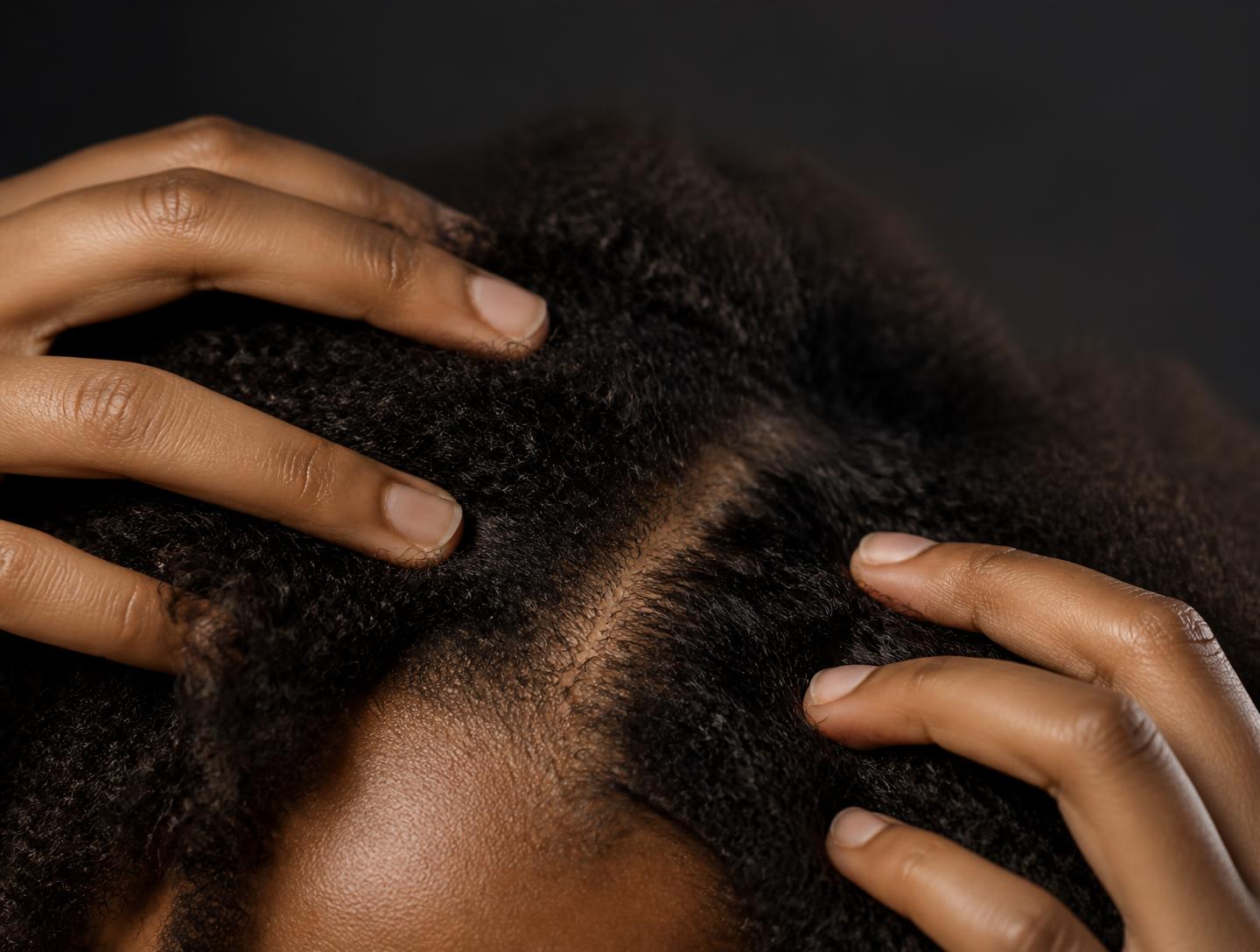
Why textured hair needs a different routine
Every bend in a curl or coil is a point where the strand is structurally weaker and where natural scalp oil has trouble traveling. The result is hair that is drier at the ends and more likely to snap under tension than straight hair of the same thickness.
That's not fragility to be fixed — it's a structure to be worked with. Water, conditioner and patience do most of the work.
Moisture first, always
Cleanse gently so you're not stripping what little oil made it down the strand. Condition every wash, focusing on the ends. Seal that moisture with a light product while the hair is still damp. Refresh with a mist between washes rather than letting the hair dry out and re-tangle.
Little Roots™ was built for exactly this rhythm on children's hair: Wash Me™, Love Me UnConditionerLy™ and Untangle Me™. Little Roots™ is a cosmetic children's hair care collection from TrichoLogics®. It is intended to cleanse, moisturize, detangle and improve manageability — it is not intended to diagnose, prevent, treat or cure hair loss or any hair or scalp condition.
Protective styling without tension
Braids, twists and simple updos protect ends from daily friction, which is genuinely useful. The problems come from execution: parts pulled too tight, edges gripped too hard, beads and extensions that add weight, and styles left in for weeks past their usefulness.
A style should never hurt going in, never leave bumps along the hairline, and never be so tight a child can't move their eyebrows. Rotate parting patterns between styles so the same lines aren't stressed repeatedly, and give the hair rest days between installs.
If a style hurts, it isn't protective — it's traction with a nicer name.
What length retention actually looks like
Parents often expect growth to feel fast. It doesn't. What changes first is texture and manageability: fewer knots, softer ends, less hair in the comb. Length becomes visible a few months later, because the hair that used to snap off is now staying attached.
Trim genuinely damaged ends instead of holding on to them. Split ends travel upward, and keeping them costs more length than removing them does.
When to bring in a professional
If a child has unexplained bald patches, sudden or heavy shedding, broken hairs confined to one area, scalp redness, flaking, sores, itching or pain, that deserves professional evaluation rather than another product. Start with the child's pediatrician or a dermatologist; a trichologist can look closely at the hair and scalp alongside that care.
A receding hairline, thinning at the temples or nape, or bare patches in a child with a history of tight styling should be evaluated rather than restyled around.
- Coiled strands are drier by structure — moisture is the whole game.
- Detangle damp, in sections, from the ends up.
- Protective styles should never hurt, pull the hairline or be worn too long.
- Length shows up when breakage stops, not when growth speeds up.
Condition on every wash, seal while the hair is still damp, refresh with a light mist between washes, and protect the hair at night with satin. Moisture is maintained daily, not restored in one treatment.
Understanding your own hair begins with an investigation.
Trichologist Dr. Leola Anifowoshe-Brown, PhD
- Founder, Texas Hair Restoration & Wellness Center
- Founder, Capillorum Institute™
- Creator of Investigative Trichology™
- Author of The Hair Loss Detective
- PhD in Organizational Leadership and Development
- Doctorate in Christian Counseling
- Harvard Medical School Executive Education (Certificate Programs)
- Certified Trichologist
New educational resources, delivered quietly.
Join our reader list for new articles on hair and scalp health. Education only — no pressure, and you can unsubscribe any time.
Trichologist Dr. Leola Anifowoshe-Brown, PhD is available for television interviews, podcasts, print media, conferences, speaking engagements and educational commentary on Hair Loss, Scalp Health, Investigative Trichology™, Hair Restoration, Women's Hair Loss, Men's Hair Loss, Hair Health Education.
This article is provided for educational purposes only and is not intended to diagnose, treat, cure, or prevent any disease. HairInvestigations.com provides evidence-informed, holistic, non-medical educational resources. Individuals experiencing hair loss or scalp concerns should consult the appropriate qualified healthcare professional.