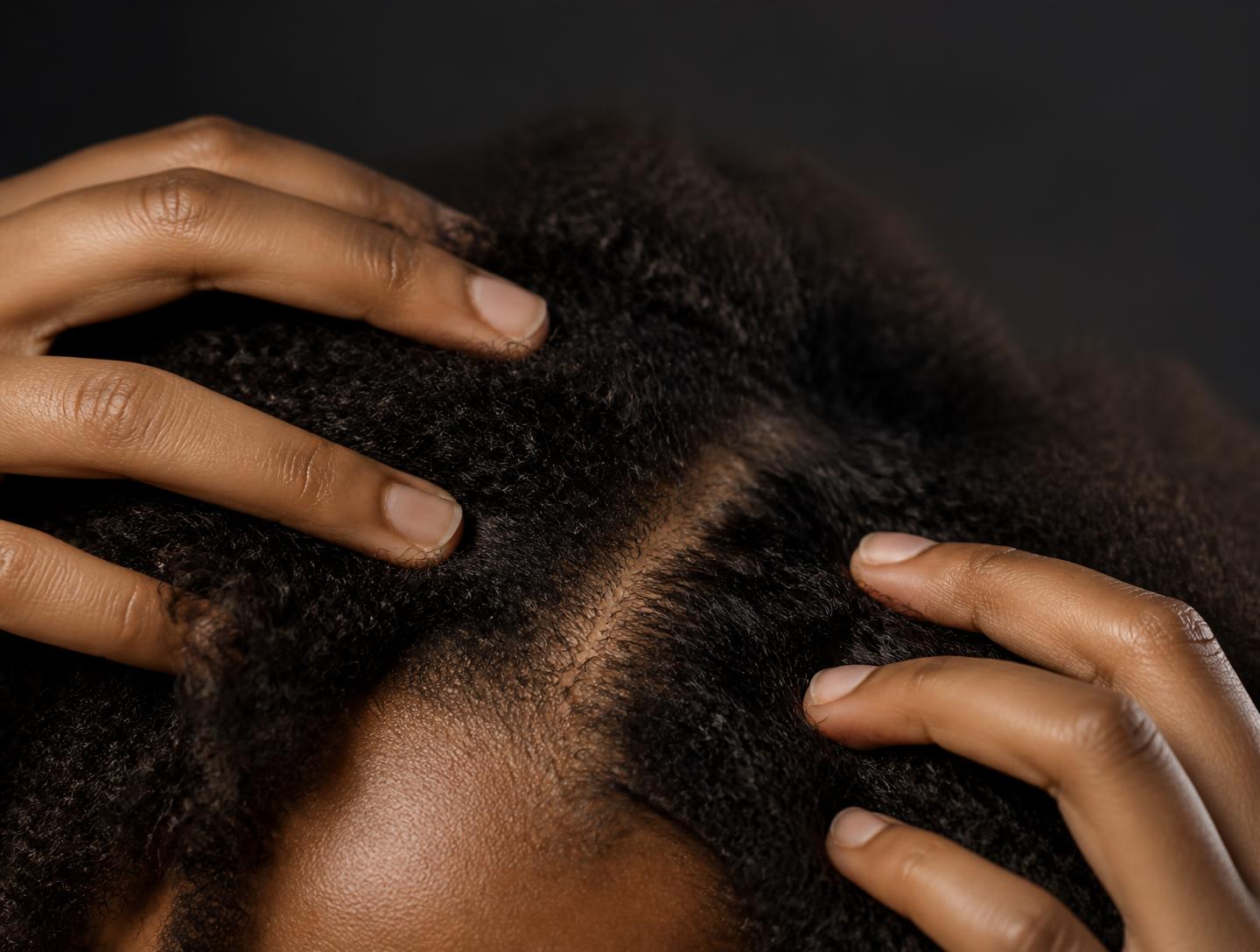
Why generic hair-loss advice often misses the mark
So much hair-loss content is written with a one-size-fits-all lens that doesn't account for the structure of coily and curly hair, the decades of styling practices many Black women and men have navigated, or conditions that show up disproportionately in Black hair like central centrifugal cicatricial alopecia (CCCA) and traction alopecia. When that context is missing, people end up chasing solutions that were never built for their hair type in the first place.
We think it's long overdue for hair-loss education to actually reflect the realities of textured hair rather than treating it as a footnote or an afterthought.
CCCA and scarring alopecia
Central centrifugal cicatricial alopecia typically starts at the crown and spreads outward in a roughly circular pattern, often with subtle symptoms like tenderness, itching, or a shiny scalp appearance before hair loss becomes obvious. It disproportionately affects Black women and has historically been under-recognized and under-discussed, which has meant delayed attention for a lot of people who noticed something was wrong years before anyone took it seriously.
Because CCCA involves scarring, the window for meaningfully addressing it before permanent damage sets in tends to be narrower than with non-scarring forms of hair loss. That's precisely why early scalp investigation matters so much for anyone noticing crown-area changes.
An investigation built with textured hair in mind
Dr. Leola Anifowoshe, PhD and our team approach every scalp with its full history in view — years of styling, chemical processing, protective styles, tension patterns, and family history all factor into the picture, rather than being treated as irrelevant details.
Our holistic trichology evaluations investigate potential contributors to hair and scalp concerns and complement the care of licensed healthcare professionals when medical evaluation or treatment is appropriate.
If you've noticed thinning along your edges, tenderness or a shiny patch at your crown, or hair that simply isn't behaving the way it used to under your usual styles, that's worth a proper look rather than another product swap.
Because CCCA involves scarring of the follicle, hair loss from established scarring is generally permanent, which is why catching and addressing it as early as possible matters so much. Early attention can help slow or stop progression.
Understanding your own hair begins with an investigation.
Trichologist Dr. Leola Anifowoshe-Brown, PhD
- Founder, Texas Hair Restoration & Wellness Center
- Founder, Capillorum Institute™
- Creator of Investigative Trichology™
- Author of The Hair Loss Detective
- PhD in Organizational Leadership and Development
- Doctorate in Christian Counseling
- Harvard Medical School Executive Education (Certificate Programs)
- Certified Trichologist
New educational resources, delivered quietly.
Join our reader list for new articles on hair and scalp health. Education only — no pressure, and you can unsubscribe any time.
Trichologist Dr. Leola Anifowoshe-Brown, PhD is available for television interviews, podcasts, print media, conferences, speaking engagements and educational commentary on Hair Loss, Scalp Health, Investigative Trichology™, Hair Restoration, Women's Hair Loss, Men's Hair Loss, Hair Health Education.
This article is provided for educational purposes only and is not intended to diagnose, treat, cure, or prevent any disease. HairInvestigations.com provides evidence-informed, holistic, non-medical educational resources. Individuals experiencing hair loss or scalp concerns should consult the appropriate qualified healthcare professional.