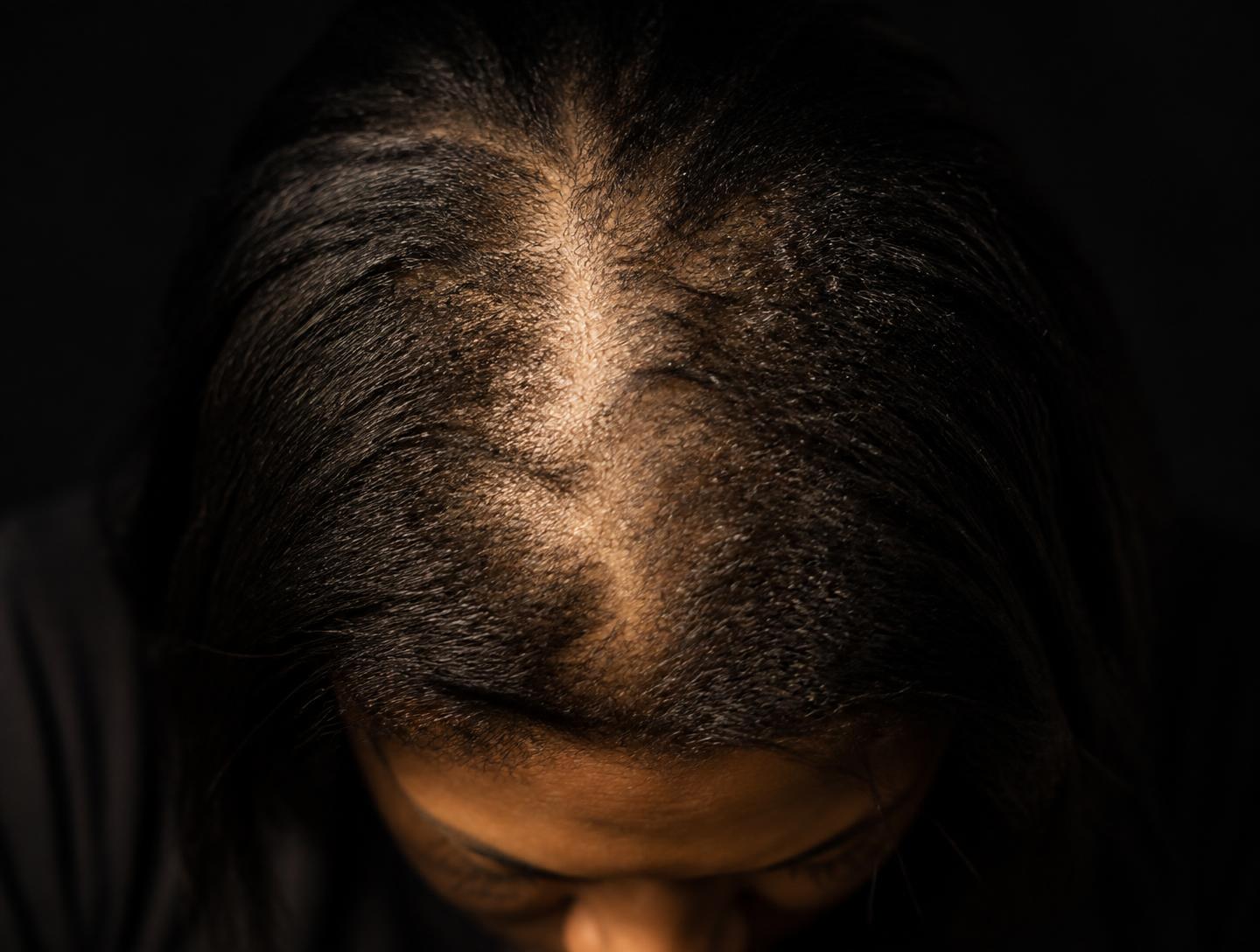
What CCCA actually is
Central centrifugal cicatricial alopecia, usually shortened to CCCA, is a type of scarring hair loss that typically begins at the crown of the scalp and gradually expands outward in a roughly circular pattern. "Cicatricial" simply means scarring — the follicle itself becomes damaged and, over time, is replaced by scar tissue that can no longer produce hair.
It disproportionately affects Black women, though it isn't exclusive to any one group, and it's been historically underdiagnosed for years because early symptoms are easy to dismiss as ordinary sensitivity or dryness.
Early signs are subtle and easy to miss
Long before visible bald patches appear, many people notice tenderness, itching, tingling, or a scalp that feels unusually sensitive at the crown. Some describe the skin looking unusually smooth or shiny in that area. Because these symptoms can come and go, and because they don't look alarming on their own, they're often brushed off for months or years before the hair loss itself becomes undeniable.
This delay is one of the most consequential parts of the CCCA story. Scarring alopecias behave very differently from non-scarring hair loss — once a follicle has scarred, it typically cannot regrow hair, which makes the window before that scarring sets in the most important part of the timeline.
What's believed to contribute to it
Researchers haven't landed on one single definitive cause of CCCA, and we're not going to pretend there's a tidy explanation with a bow on it. What is generally understood is that a combination of genetic predisposition and inflammatory processes at the follicle level appears to be involved, and that certain styling practices may act as contributing stressors on scalps that are already predisposed.
This is exactly why treating CCCA as purely a "styling problem" or purely a "genetic problem" oversimplifies something that's genuinely complex — and why a real investigation into an individual scalp matters more than a generic explanation.
Why early investigation is everything with CCCA
Because the condition progresses through active inflammation before scarring becomes permanent, the period where something can meaningfully be done is genuinely time-limited in a way that most other types of hair thinning aren't. That's not meant to alarm anyone — it's meant to underscore why we take crown-area tenderness, itching, or thinning seriously from the very first conversation.
Dr. Leola Anifowoshe, PhD has built much of her investigative approach around exactly this kind of early-pattern recognition, because for CCCA in particular, the earlier the scalp is properly evaluated, the more options remain on the table.
Our holistic trichology evaluations investigate potential contributors to hair and scalp concerns and complement the care of licensed healthcare professionals when medical evaluation or treatment is appropriate.
CCCA is most commonly diagnosed in Black women, particularly in midlife, though anyone can theoretically develop scarring alopecia patterns. It's believed to involve both genetic and inflammatory factors.
Understanding your own hair begins with an investigation.
Trichologist Dr. Leola Anifowoshe-Brown, PhD
- Founder, Texas Hair Restoration & Wellness Center
- Founder, Capillorum Institute™
- Creator of Investigative Trichology™
- Author of The Hair Loss Detective
- PhD in Organizational Leadership and Development
- Doctorate in Christian Counseling
- Harvard Medical School Executive Education (Certificate Programs)
- Certified Trichologist
New educational resources, delivered quietly.
Join our reader list for new articles on hair and scalp health. Education only — no pressure, and you can unsubscribe any time.
Trichologist Dr. Leola Anifowoshe-Brown, PhD is available for television interviews, podcasts, print media, conferences, speaking engagements and educational commentary on Hair Loss, Scalp Health, Investigative Trichology™, Hair Restoration, Women's Hair Loss, Men's Hair Loss, Hair Health Education.
This article is provided for educational purposes only and is not intended to diagnose, treat, cure, or prevent any disease. HairInvestigations.com provides evidence-informed, holistic, non-medical educational resources. Individuals experiencing hair loss or scalp concerns should consult the appropriate qualified healthcare professional.