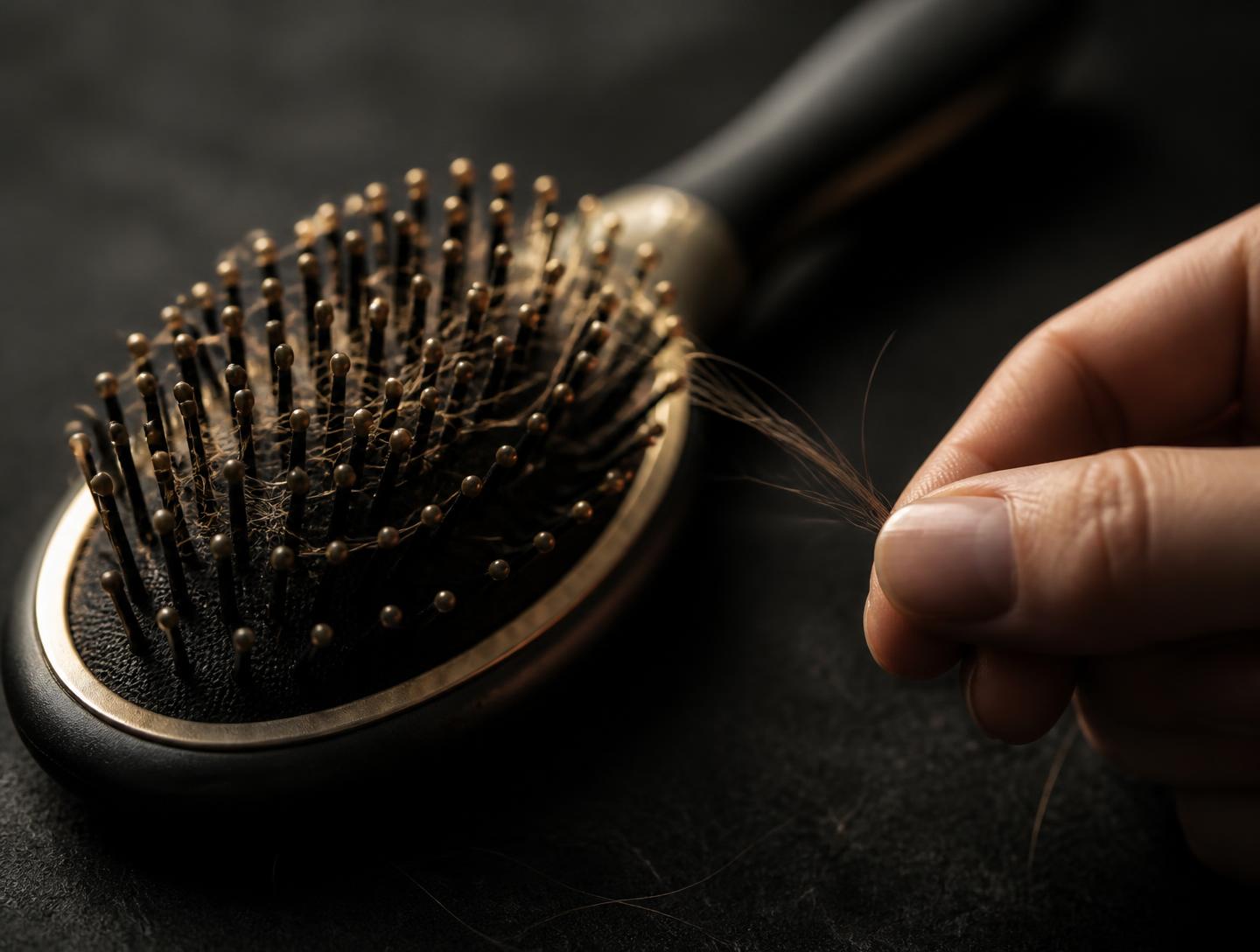
Normal shedding is part of a healthy cycle
Hair grows in cycles — a long growth phase, a brief transition phase, and a resting phase that ends with the strand releasing to make room for a new one. Losing somewhere around 50 to 100 hairs a day is a completely normal part of that cycle, even on a perfectly healthy head of hair. It's easy to notice this shedding in concentrated moments — brushing, washing, running your fingers through a ponytail — and mistake ordinary turnover for a problem.
One useful way to check yourself: if the hairs you're finding have a tiny white bulb at the root, that's usually a normal, resting-phase hair completing its cycle, not a sign of breakage or disease.
What actually signals a problem
True hair loss is less about the number of strands on a given day and more about a pattern over time — a part that's visibly widening, a ponytail that's noticeably thinner than it was a year ago, patches of visible scalp, or a hairline that's receded compared to old photos. These changes tend to be gradual but consistent, rather than a single dramatic day.
There's also a middle category worth knowing about: excessive shedding, or telogen effluvium, where significantly more hair than usual is being lost daily, often triggered by stress, illness, or a major life change, but without the follicle itself being permanently damaged.
The shower drain test isn't reliable on its own
So many people try to diagnose themselves by counting strands in the shower drain, and honestly, it's one of the least reliable ways to assess your hair. Shower frequency, hair length, water pressure, and how often you brush all change how much hair appears to be shedding on a given day, without reflecting the actual health of your follicles.
A far more useful approach is tracking density and pattern over months — photos of your part line, the thickness of your ponytail, or simply comparing how your hair looks and feels now versus six months ago.
When it's time to actually investigate
If you're noticing a consistent pattern of change rather than a one-off worrying shower, that's the signal to move from self-monitoring to an actual scalp evaluation. This is exactly the gap our Hair Investigation™ is built to close — looking at your scalp, your history, and your timeline rather than leaving you to guess based on strand counts.
Our holistic trichology evaluations investigate potential contributors to hair and scalp concerns and complement the care of licensed healthcare professionals when medical evaluation or treatment is appropriate.
Somewhere between 50 and 100 hairs a day is generally considered part of a normal growth cycle, though this can vary somewhat by hair length and thickness.
Understanding your own hair begins with an investigation.
Trichologist Dr. Leola Anifowoshe-Brown, PhD
- Founder, Texas Hair Restoration & Wellness Center
- Founder, Capillorum Institute™
- Creator of Investigative Trichology™
- Author of The Hair Loss Detective
- PhD in Organizational Leadership and Development
- Doctorate in Christian Counseling
- Harvard Medical School Executive Education (Certificate Programs)
- Certified Trichologist
New educational resources, delivered quietly.
Join our reader list for new articles on hair and scalp health. Education only — no pressure, and you can unsubscribe any time.
Trichologist Dr. Leola Anifowoshe-Brown, PhD is available for television interviews, podcasts, print media, conferences, speaking engagements and educational commentary on Hair Loss, Scalp Health, Investigative Trichology™, Hair Restoration, Women's Hair Loss, Men's Hair Loss, Hair Health Education.
This article is provided for educational purposes only and is not intended to diagnose, treat, cure, or prevent any disease. HairInvestigations.com provides evidence-informed, holistic, non-medical educational resources. Individuals experiencing hair loss or scalp concerns should consult the appropriate qualified healthcare professional.