Part of Why Am I Losing My Hair?
Hair loss is evidence, not a diagnosis
When people first notice a change, the instinct is to start shopping — the best shampoo, the newest serum, another vitamin, whatever a video recommended this week. But hair loss is not solved by guessing. Hair loss is rarely the problem. Hair loss is the clue.
One of the biggest misconceptions is that there is one cause and one solution. In reality, what you see in the mirror is the visible end of a much longer story. Some people are releasing more strands from the follicle. Others have breakage that only looks like thinning while the follicles keep producing. Some see the centre part widening; others notice recession at the temples, or tenderness, itching, flaking, oiliness or a change in how the scalp feels.
Every one of those findings is another clue. So the investigation doesn't begin with a bottle. It begins with better questions: when did this start, how has it progressed, what else changed around the same time, and what pattern is forming?
The question isn't "what product should I buy?" It's "what is my hair trying to tell me?"
Every timeline tells a story
One of the first things we investigate is the timeline. Did the change follow childbirth? Surgery? A serious illness? Menopause? Rapid weight loss? Starting a GLP-1 medication? A stretch of prolonged emotional stress? A medication change?
Hair often responds weeks or even months after the event that set it in motion. By the time shedding becomes obvious, the original trigger has usually been forgotten. That is exactly why the timeline matters — without knowing when something happened, it is very hard to understand why it is happening now.
An investigation looks beyond the hair
Many people assume a trichologist only looks at hair. We look at the relationship between the hair, the scalp, the person and the factors influencing both.
The hair itself: is it shedding, breaking, growing more slowly, coming in finer, changing texture? The scalp: is it calm, congested, tender, flaking, inflamed-looking? The history: health events, medications, family pattern, life transitions. The routine: heat, tension, protective styling, relaxers, colour, wash frequency — not to label practices good or bad, but to ask whether they are contributing to the pattern in front of us.
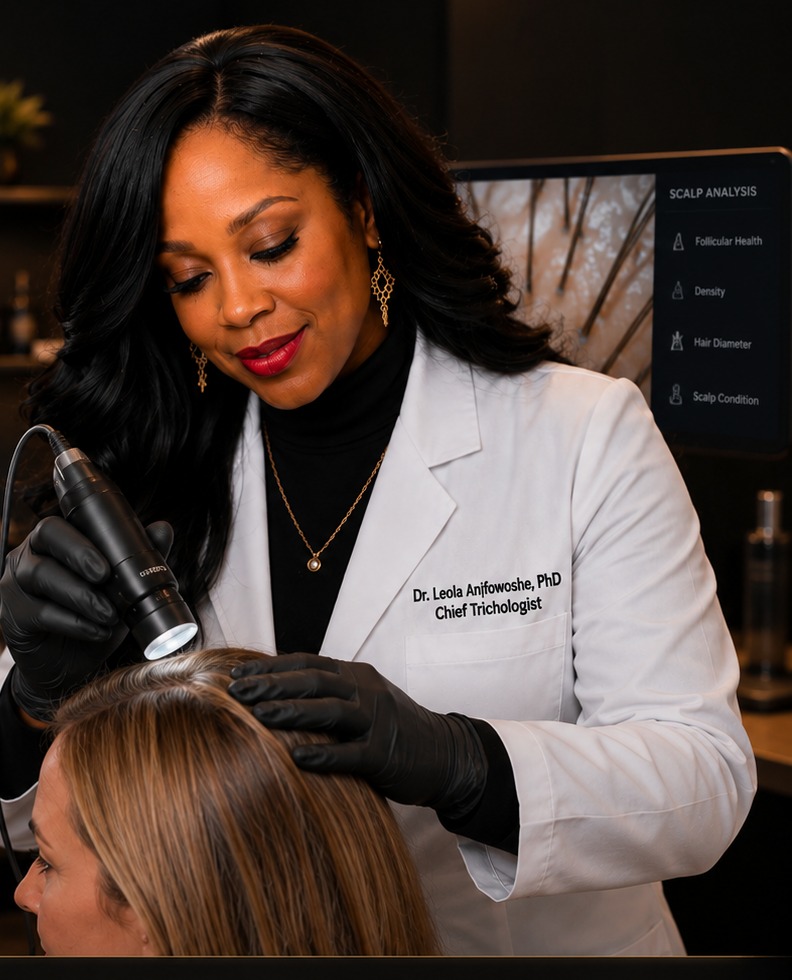
And then progress. Magnified imaging, consistent photography and documented follow-up let today's findings be compared with tomorrow's. Evidence should be measured, not guessed.
Where medical care fits
Our work is non-medical and educational. When a pattern or history suggests medical diagnosis, laboratory testing or prescription treatment is appropriate, we say so and refer — sudden patches, scalp pain, sores, signs of infection and rapidly worsening loss belong in a physician's or dermatologist's office without delay.
The two roles fit together well. A physician diagnoses and treats. We observe closely, educate, guide daily care and track change over time. Clients get the most when both roles are doing their own job.
- Hair loss is usually the final chapter of a longer story, not the story itself.
- Timelines matter: hair often reacts weeks or months after the event that triggered it.
- An investigation looks at the hair, the scalp, the person, the history and the routine together.
- Evidence should be documented and measured over time — not guessed at.
It's our structured way of organising the evidence — the hair, the scalp, your timeline, your health history and your routine — before any recommendations are made, so a plan fits your actual case.
- 1.Hair loss: signs and symptomsAmerican Academy of Dermatology Association
Understanding your own hair begins with an investigation.
Trichologist Dr. Leola Anifowoshe-Brown, PhD
- Founder, Texas Hair Restoration & Wellness Center
- Founder, Capillorum Institute™
- Creator of Investigative Trichology™
- Author of The Hair Loss Detective
- PhD in Organizational Leadership and Development
- Doctorate in Christian Counseling
- Harvard Medical School Executive Education (Certificate Programs)
- Certified Trichologist
New educational resources, delivered quietly.
Join our reader list for new articles on hair and scalp health. Education only — no pressure, and you can unsubscribe any time.
Trichologist Dr. Leola Anifowoshe-Brown, PhD is available for television interviews, podcasts, print media, conferences, speaking engagements and educational commentary on Hair Loss, Scalp Health, Investigative Trichology™, Hair Restoration, Women's Hair Loss, Men's Hair Loss, Hair Health Education.
This article is provided for educational purposes only and is not intended to diagnose, treat, cure, or prevent any disease. HairInvestigations.com provides evidence-informed, holistic, non-medical educational resources. Individuals experiencing hair loss or scalp concerns should consult the appropriate qualified healthcare professional.